1. Introduction
Despite decades of conducting verification activities by the International Atomic Energy Agency (IAEA) over Islamic Republic of Iran's nuclear facilities and numerous IAEA reports confirming the non-diversion of declared nuclear material as well as the peaceful nature of all those nuclear facilities' activities, the entire facilities/sites were subjected to military attacks by the United States and the Zionist regime.
Following these events, not only were these attacks not condemned by the IAEA, but with the issuance of the Board of Governors' resolution on November 20, 2025, against Iran, was requested—without any legal basis—to fulfill its commitments in the field of nuclear non-proliferation under previous United Nations Security Council (UNSC) resolutions (2006-2010), including the "suspension of all enrichment-related and reprocessing activities, including research and development, and work on all heavy water-related projects."
This raises the question of whether a similar approach has been adopted towards the IAEA for other member states in comparable situations. To answer this question, this report attempts to compare the IAEA's reaction to direct military attacks on Iran's nuclear facilities with its response to security incidents at nuclear facilities in Ukraine during the military conflict with the Russian Federation.
2. History of Military Attacks on Nuclear Facilities
Prior to the military attacks on Iran's nuclear facilities, some attacks on nuclear sites, auxiliary buildings, or factories associated with nuclear activities occurred in the following instances:
The Norsk Hydro heavy water production facility in Telemark, Norway, by Allied forces between 1942 and 1944.
The Hungnam Chemical Complex in North Korea during U.S. airstrikes in the Korean War in 1950 (this complex was used for processing monazite to extract thorium for the Soviet nuclear program).
The Osirak reactor in Iraq by the Zionist regime in 1981.
The Bushehr Nuclear Power Plant in Iran (under construction) during the Iran-Iraq War between 1984 and 1988 by Iraq.
Facilities in Iraq during the Gulf War by the United States between 1990 and 1993.
Facilities in the Al-Kibar region in eastern Syria by the Zionist regime in September 2007.
Auxiliary facilities of Ukrainian power reactors during military conflicts with Russia from February 2022 to February 2023.
3. Comparison of Different Dimensions of Military Attacks on Nuclear Facilities in Iran and Ukraine
3-1. The Extent of Military Attacks on Nuclear Facilities / Related Sites
Iran:
A review of history shows that prior to the attacks on Iran's nuclear facilities, military strikes on facilities/sites occurred at 3 distinct levels, none of which contained IAEA-safeguarded nuclear material:
Level 1: Attacks on plants producing non-nuclear materials.
Level 2: Attacks on nuclear facilities under construction or facilities alleged to involve nuclear activities.
Level 3: Attacks on auxiliary buildings of nuclear facilities/power plants.
Military attacks on Iran's nuclear facilities went beyond these previous levels for the following reasons:
For the first time in history, military strikes directly targeted facilities containing IAEA-safeguarded nuclear material.
These military strikes targeted Iran's nuclear fuel cycle facilities—including the Uranium Conversion Facility, the Nuclear Fuel Fabrication Plant, uranium enrichment plants, and a research reactor under construction—as well as non-nuclear equipment and material production centers (the heavy water production plant and centrifuge manufacturing and assembly workshops).
Ukraine:
According to IAEA reports, only the following incidents were classified as attacks on Ukraine's nuclear facilities:
The occupation of the Chernobyl Nuclear Power Plant (NPP) from February 24 to March 31, 2022, without any reported damage.
Damage to auxiliary facilities, including power transmission lines and electrical generators at the Khmelnitsky, Rivne, South Ukraine, and Zaporizhzhia NPPs (Figure 1). It should be noted that the Zaporizhzhia NPP was annexed to Russia on October 2, 2022, following its occupation on March 4, 2022.
In February 2025, IAEA inspectors reported that after a drone strike on the Chernobyl NPP, the "New Safe Confinement" structure over the damaged 1986 reactor sustained physical damage.


Figure 1: damage at the Zaporizhzhia NPP
On the IAEA's reports, in addition to details on attacks against auxiliary facilities at Ukrainian NPPs, coverage was also given to events unrelated to nuclear safety and security in nuclear reactors—such as attacks on the Zaporizhzhia training center, the Kharkiv Neutron Source installation, the Kyiv Institute for Nuclear Research, and cyberattacks on Ukraine's communications network (disconnection of mobile networks) (Figure 2).

Figure 2:Damage to the Kharkiv Neutron Source installation
Assessment: During the military conflict between Ukraine and Russia, the main reactor buildings containing nuclear material were not attacked and only minor damage to auxiliary facilities at Ukrainian NPPs has been reported. |
3-2. International reactions and measures
Iran:
In his June 2025 report, the IAEA Director General (DG) presented a comprehensive assessment of past and present outstanding issues in Iran's nuclear program. In this report, by questioning the peaceful nature of Iran's nuclear activities, he paved the way for a resolution by the Board of Governors at its June 2025 meeting stating Iran's non-compliance with its safeguards obligations.
Following this resolution, military strikes by the Zionist regime and the U.S. were carried out on IAEA-safeguarded Iranian nuclear facilities. These attacks—which were met with silence from international bodies, including the IAEA's policy-making and executive organs (the UN and the Board of Governors)—not only were in fact the military strikes on safeguarded facilities left uncondemned, but also two subsequent resolutions in November 2025[1] and June 2026[2] reiterated that Iran must comply with non-proliferation commitments under previous UNSC resolutions, including the "suspension of all enrichment- and reprocessing-related activities, R&D, and work on heavy water-related projects."
Ukraine:
Due to the conflict of some countries with Russia, have raised the issue at the following levels by magnifying attacks limited to ancillary facilities, including power transmission lines and electrical generators, rather than the main buildings containing nuclear material at the country's NPPs:
United Nations: On March 4, 2022, the DG submitted a report on the nuclear safety and security situation in Ukraine to the UN Security Council. In 2022, the UN General Assembly adopted a resolution[3] declaring that the "attempted illegal annexation" of four regions of Ukraine on October 4, 2022, has no validity under international law.
IAEA General Conference: Through the General Conference's annual resolutions on nuclear safety, security, and safeguards since 2022, certain clauses have stressed the necessity for all member states to respect the nuclear safety, security, and safeguards of peaceful nuclear facilities under all circumstances. Furthermore, safeguards resolutions requested all member states to "refrain from attacks or threats of attacks against or in the vicinity of nuclear facilities devoted to peaceful purposes".
IAEA Board of Governors: The consequences of those attacks were addressed across multiple Board meetings, resulting in 3 resolutions in 2022[4], 3 in 2024[5], and 1 in 2026[6]. Notably, in its first resolution on Ukraine, the Board "deplores the actions of the Russian Federation in Ukraine", expresses "grave concern that the aggression is impeding the IAEA from fully and safely conducting safeguards verification activities", and requests that "the DG and Secretariat continue to closely monitor the situation, focusing on safety and security and report to the Board as necessary".
In his introductory statement to the Board on March 2, 2022, the DG outlined the "Seven Pillars" for ensuring nuclear safety and security during an armed conflict.
3-3. The IAEA’s Reaction to Military Attacks
Iran:
Following the military strikes on IAEA-safeguarded nuclear facilities in Iran, the IAEA's actions were as follows:
Statements by the DG: The DG's first press statement on the attacks was published on June 19, 2025, and only 6 updates have been posted on the IAEA website to date. In the first media statement, while recalling past General Conference resolutions prohibiting military attacks against nuclear facilities devoted to peaceful purposes and the threat thereof, merely listed the damaged facilities/sites and requested regular, timely technical data regarding damaged nuclear facilities and sites to inform the international community, ensure effective response, and assist with emergency situations in Iran.
Reports by the DG: Following the military attacks on Iran's nuclear facilities, the DG issued a total of 9 reports: 4 reports in 2025 (2 reports on the Implementation of the NPT Safeguards Agreement[7], 2 reports on Verification and monitoring in the Islamic Republic of Iran in light of UNSC resolution 2231 (2015)[8]) and 5 reports in 2026 (2 reports on the Implementation of the NPT Safeguards Agreement and relevant provisions of the UNSC resolutions in the Islamic Republic of Iran[9], 2 reports on Verification and monitoring in the Islamic Republic of Iran in light of UNSC resolution 2231 (2015)[10], and 1 corrigendum[11]).
Assessment: These reports focused strictly on Iran's safeguards/beyond safeguards commitments and verifying the suspension of enrichment, reprocessing, and R&D activities under pervious UNSC resolutions (2006–2010). Throughout these reports, the use of force to eliminate Iran's nuclear industry and deprive it of its Comprehensive Safeguards Agreement (CSA) rights was ignored. |
Ukraine:
The IAEA's primary actions regarding Ukraine during the conflict include:
Statements by the DG: The DG's first statement on Ukraine was issued on February 24, 2022, with regular updates through July 13, 2026 (reaching Statement No. 356). These statements focused predominantly on nuclear safety and security at Ukrainian facilities.
Reports by the DG: the DG issued a total of 18 reports: 5 in 2022 (2 summary reports[12], 2 reports to the Board of Governors[13] and 1 corrigendum[14]), 5 reports in 2023 (1 summary report[15] , 3 reports to the Board of Governors[16] and 1 corrigendum[17]), 5 reports in 2024 (1 biennial report[18] and 4 reports to the Board of Governors[19]), 4 reports in 2025 (4 reports to the Board of Governors[20]) and 1 report in 2026 (1 report to the Board of Governors[21]).
3-4. The IAEA's Compensatory Measures and Actions in dealing with Military Attacks
Iran:
Following military strikes during the 12-day war and the third imposed war against Iran’s nuclear facilities/sites, and non-nuclear material and equipment production plants/workshops, no protective or compensatory measures were taken by the IAEA. Instead, by resorting to the Snapback Mechanism as a pretext, the IAEA resumed reporting based on previous UNSC resolutions demanding the suspension of enrichment, reprocessing, R&D, and heavy water production.
Ukraine:
Following minor damage to auxiliary facilities at Ukrainian NPPs during the military conflict, the DG introduced the "Seven Pillars" and "Five Concrete Principles" frameworks under the pretext of ensuring nuclear safety and security over Ukrainian nuclear facilities. In the next step, under its Comprehensive Assistance Programme for Ukraine, the IAEA provided support missions, psychological/medical support, technical assistance, and training workshops as following:
Design and establishment of the "Seven Pillars" and "Five Concrete Principles":
For the first time, the DG’s introductory statement to the Board of Governors on 2 March 2022 outlined the “seven pillars” necessary to ensure nuclear safety and security during an armed conflict. Also, on May 30, 2023, DG presented the "Five Concrete Principles" to the UNSC to prevent a nuclear accident at Zaporizhzhia. Design and establishment of these Pillars and Principles clearly demonstrate the discriminatory nature of the IAEA's approach addressing military attacks in Ukraine and Iran.
Comprehensive Programme Of Technical Support and Assistance to Ukraine[22]:
Support and Assistance Missions to Ukraine NPPs[23]: In order to establishment of the “seven pillars” to ensure the nuclear safety and security of Ukrainian nuclear facilities, the IAEA has had a continuous staff members presence at Zaporizhzhia NPP (ISAMZ, Sept 1, 2022) and four other NPPs (Jan 16–23, 2023). With these missions established at the five Ukraine nuclear sites, five teams of IAEA staff members, comprising approximately 13 personnel, have been continuously present in Ukraine without any interruption. As of 1 June 2026, a total of 271 missions comprising 181 Agency staff members had been deployed as part of the continued presence at all five nuclear sites in Ukraine (totaling 600 person-months or 18,000 person-days)[24].
Assessment: Unlike in Iran, the presence of The IAEA's inspectors in the Ukraine were ostensibly justified by the need to stabilize the nuclear safety and security situation at Ukrainian NPPs, but in reality, it was to prevent the cessation of energy production at that country's NPPs. |
Medical and Coordination Missions: In these missions, the assessment of the capacity to provide medical support and care, including health screening, health monitoring and mental health support, for operating personnel at the Ukraine NPPs is performed.
Nuclear Safety/Security Missions at Electrical Substations: Throughout these missions, the IAEA assesses the risks and extent of damage to power substations that are known to be essential for maintaining the nuclear safety and security of Ukraine’s NPPs. The IAEA, in line with the its nuclear security guidelines, considers these power substations to be critical infrastructure essential for the deployment of nuclear Security Measures and Systems, with the aim of preventing military attacks on them; and considered any instability in the Ukrainian power grid as a set of scenarios with different levels of risk to nuclear safety. This is while many of the safety systems of NPPs, especially the final safety layers, are passive.
Technical Support and Assistance for Nuclear Safety and Security: The IAEA implemented a comprehensive program of support and technical assistance to Ukraine, including the provision of equipment related to nuclear safety and security, on-site technical support through expert missions and the continued presence of IAEA staff members at five nuclear sites in Ukraine, a medical assistance program for NPP operators, and assistance in managing the medium and long term environmental, social and economic impact of the flood (!) following the destruction of the Kakhovka dam in Kherson Oblast. This program also includes remote assistance and the deployment of emergency assistance if needed.
By June 1, 2026, the IAEA delivered 232 shipments of equipment valued at €25.8 million to 42 end-users across Ukraine (141 shipments of safety and security equipment, 67 shipments of medical supplies/ambulance, and 24 shipments of nuclear or isotope-based equipment and supplies (Figure 4)).


Figure 4: Digital color Doppler ultrasound system and an ambulance device
4. Conclusion
The IAEA's reaction to military attacks on nuclear facilities in Iran and Ukraine displays a clear contrast. In reaction to illegal and widespread attacks on safeguarded Iran’s nuclear facilities, the IAEA took no action in line with protection of Iran's inalienable rights to benefit from peaceful nuclear activities, instead demanding inspections of damaged sites. Conversely, in response to minor damage at auxiliary installations of Ukrainian NPPs, IAEA passed numerous resolutions and statements, and exceeded its statutory mandate to conduct extensive, continuous monitoring missions for ensuring nuclear safety and security of Ukraine NPPs.
This double standard stems from the IAEA's structure, where the main power rests with the Board of Governors rather than the General Conference. In other words, dominance by Western countries has shifted the Board's decision-making away from the IAEA's technical mandate toward politically driven agendas.
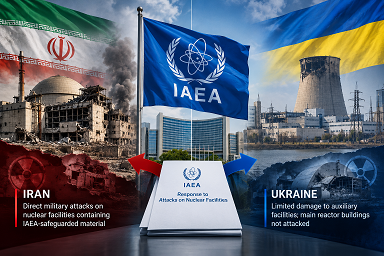
To clarify the issue, a summary of the discussions regarding military attacks on Iranian and Ukrainian nuclear facilities in various indicators is summarized in Table 1.
ONE SUBJECT, TWO DIFFERENT APPROACHES
The IAEA’s Reaction to Attacks on Nuclear Facilities in Iran and Ukraine
 | Limited Scope of Attacks • No attack on reactor buildings containing nuclear material. • Damage only to auxiliary facilities (power lines, generators, buildings, etc.). • Occupation of Zaporizhzhia and Chernobyl NPPs. |  EXTENT OF ATTACKS | Illegal & Unprecedented & Extensive Attacks • Direct attacks on facilities containing IAEA-safeguarded nuclear material. • Targeted the entire fuel cycle: conversion, enrichment, fuel fabrication and research reactor including heavy water plant and centrifuge manufacturing workshops. |  |
 | Widespread Condemnation • UN General Assembly resolution (2022) |  UN REACTION | Silence or Implicit Support • None |  |
 | Strong Reaction • Added clauses in 3 annual resolutions (from 2022) emphasizing nuclear safety, security, and safeguards for peaceful facilities under all conditions. |  IAEA GENERAL CONFERENCE REACTION | Neutral/Discriminatory Reaction • None |  |
• Issued 7 resolutions deploring Russian actions, requesting closely monitoring focusing on safety/security and expressing grave concern on impeding the IAEA from fully and safely conducting safeguards verification activities. |  IAEA BOARD OF GOVERNORS REACTION | • No condemnation of military attacks. • Issued resolutions (Nov 2025, June 2026) requiring Iran to implement past UNSC non-proliferation commitments (suspending enrichment/reprocessing). |  | |
• Issued 356 press statements. • Submitted 18 official reports on safety/security and confirming no proliferation concerns. |  IAEA DG REACTION | • Issued 7 press statements listing damaged locations. • Submitted 9 official reports focusing on safeguards obligations and nuclear activity suspensions. |  | |
• Emphasize on ensuring nuclear safety and security at Ukraine’s NPPs. |  FOCUS OF DG ACTIVITIES | • Emphasize on implementation of nuclear safeguards commitments. |  | |
 | Active Measures & Exceptional Actions • Establishment of the "Seven Indispensable Pillars" (Mar 2022). • Adoption of the "Five Concrete Principles" for Zaporizhzhya NPP (May 2023). • Increased inspections, satellite monitoring, and continuous presence. • Additional €1.7 million in extra-budgetary funds for enhanced monitoring in 2025. |  IAEA COMPENSATORY MEASURES | No Exceptional Measures • None | |
 | Protection-Oriented Approach Focus on protecting nuclear facilities and IHL principles regardless of the context. |  | Biased & Obligation-Oriented Approach Focus primarily on the safeguards obligations, regardless of attacks, context and IHL considerations. |  |
Table 1: Comparison of Various Indicators of Military Attacks on Nuclear Facilities in Ukraine and Iran
[1] GOV/2025/71, 20 November 2025
[2] GOV/2026/40, 10 June 2026
[3] A/RES/ES11/4
[4] GOV/2022/17, GOV/2022/58 and GOV/2022/71
[5] GOV/2024/18, GOV/2024/51 and GOV/2024/73
[6] GOV/2024/25
[7] GOV/2025/53, 3 September 2025 and GOV/2025/65, 12 November 2025
[8] GOV/2025/50, 3 September 2025 and GOV/INF/2025/14, 12 November 2025
[9] GOV/2026/8, 27 February 2026 and GOV/2026/33, 4 June 2026
[10] GOV/INF/2026/5, 27 February 2026 and GOV/INF/2026/9, 4 June 2026
[11] GOV/2026/33/Corr.1, 5 June 2026
[12] Summery Reports, “24 Feb-28 Apr. 2022” and “28 Apr.-5 Sep.”
[13] GOV/2022/52 and GOV/2022/66
[14] GOV/2022/52/Corr.1
[15] Summary Report, “Feb. 2022-Feb.2023”
[16] GOV/2023/30, GOV/2023/44 and GOV/2023/59
[17] GOV/2023/59/Corr.1
[18] Two Years of IAEA Continued Presence at the Zaporizhzhya NPP
[19] GOV/2024/9, GOV/2024/30, GOV/2024/45 and GOV/2024/63
[20] GOV/2025/11, GOV/2025/26, GOV/2025/54 and GOV/2025/66
[21] GOV/2026/7
[22] GOV/2023/59, 16 November 2023
[23] the IAEA Support and Assistance Mission to Zaporizhzhya NPP (ISAMZ), to Rivne NPP (ISAMIR), to the South Ukraine NPP (ISAMISU), to the Khmelnytskyy NPP (ISAMIK) and to the Chornobyl NPP (ISAMICH).
[24] GOV/2026/32, 11 June 2026